



















Breville Barista Express Impress vs Standard Model – Which Should You Buy?

For coffee enthusiasts upgrading their home barista setup USA, choosing between the Breville Barista Express Impress and the Standard Barista Express is one of the most practical decisions you’ll make.
Both machines are proven semi-automatic espresso systems with integrated grinders, manual steam wands, and stable temperature regulation. Both are capable of producing cafe-level drinks at home. But they differ in workflow, maintenance, and long-term user experience.
Let’s break it down clearly.
Quick Verdict
Choose the Impress if you want:
- Easier espresso puck preparation
- Built-in assisted tamping
- Faster learning curve
- Improved espresso shot consistency
Choose the Standard if you want:
- Lower purchase price
- Full manual control
- More involvement in grind size calibration
- Strong overall value
Typical U.S. pricing:
- Standard: $699–$749
- Impress: $899–$949
The internal brewing system is nearly identical. The difference lies in usability.
Core Technical Overview
Both machines include:
- 15-bar Italian pump (regulated to ~9 bars during extraction)
- Thermocoil heating system with PID temperature stability
- Pre-infusion pressure control for even saturation
- 54mm stainless steel portafilter
- Integrated conical burr grinder
These features allow proper pressure profiling and stable brewing temperatures, which directly influence flavor balance and crema development.
When properly calibrated, both machines can deliver balanced shots with strong body and clean finish.
Grinder & Grind Size Calibration
The built-in conical burr grinder on both models allows fine grind size calibration for different roast levels.
You can:
- Adjust grind fineness
- Control dose timing
- Dial in for lighter or darker beans
With the Standard model, grind size calibration and dosing rely entirely on your judgment.
With the Impress:
- The machine provides feedback on dosing
- Assisted tamping reduces variability
- Early dialing-in tends to waste fewer beans
For beginners, this can noticeably improve espresso shot consistency during the first few weeks of ownership.
Tamping & Espresso Puck Preparation
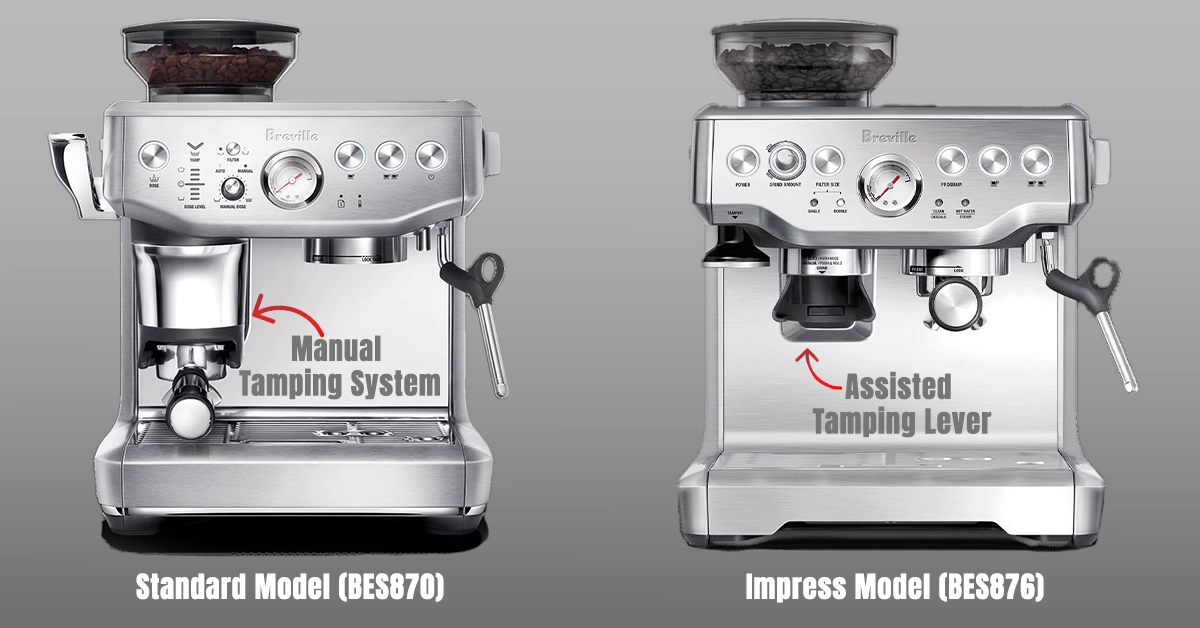
This is the most significant difference.
Impress Model (BES876)
- Integrated lever-based tamp system
- Applies consistent tamp force automatically
- Cleaner countertop experience
- Reduces uneven water flow through the puck
Standard Model (BES870)
- Manual stainless steel tamper included
- Full control over tamp force
- More room for user error
- Greater skill involvement
If you enjoy refining technique and manually preparing each puck, the Standard offers more control. If you want predictable results without perfecting tamp mechanics, the Impress simplifies the process.
Steam Wand & Milk Texturing
Both Breville Barista Express Impress and Standard Model machines use manual steam wands capable of producing silky milk foam suitable for cappuccinos and lattes.
Performance is similar:
- Strong steam pressure
- Capable of proper milk texturing
- Fully manual control
Neither model automates milk frothing. Skill matters more than hardware differences here.
Warranty Information (U.S.)
Both machines typically include:
- 1-Year Limited Manufacturer Warranty (U.S.)
- Customer support through Breville USA
- Availability of replacement parts (gaskets, baskets, filters)
Breville’s U.S. support network is generally considered reliable, especially compared to lower-cost imported brands.
Warranty terms are essentially identical between the two models.
Dimensions & Countertop Space
Both machines are compact for an all-in-one espresso system.
Approximate dimensions:
- Width: 12.5 inches
- Depth: 13.8 inches
- Height: 15.9 inches
They require:
- Adequate vertical clearance for bean hopper removal
- Side space for steam wand use
For most American kitchens, they fit comfortably under standard cabinetry, but measure your clearance if cabinets are low.
The countertop footprint is virtually identical between models.
Water Tank Capacity Comparison
Both machines include:
- Removable 67 oz (2-liter) water reservoir
- Rear-mounted tank
- Replaceable water filter
There is no capacity difference between the Impress and Standard model.
For daily use in a household of 1–3 espresso drinkers, refilling typically occurs every few days depending on milk drinks and cleaning cycles.
Build Materials & Durability
Both models feature:
- Brushed stainless steel exterior panels
- Stainless steel portafilter
- Metal steam wand
- Durable internal thermocoil heating system
The stainless steel body construction provides better heat retention and durability compared to plastic-heavy budget machines.
In terms of build quality, there is no meaningful structural difference between the Impress and Standard versions.
Real-World Maintenance Differences
Here is where a subtle difference appears.
Impress Maintenance
- Assisted tamping system requires occasional cleaning
- Slightly more internal components
- Dosing mechanism adds one extra cleaning step
Standard Maintenance
- Fewer mechanical components
- Simpler internal design
- Slightly easier long-term serviceability
Both machines require:
- Regular backflushing
- Descaling (depending on water hardness)
- Steam wand purging after use
- Grinder cleaning
In practice, maintenance effort is similar. The Standard may have a slight advantage in long-term mechanical simplicity.
Comparison With Other Popular Espresso Machine Types
Compared to Fully Automatic Machines
Fully automatic machines:
- Grind, tamp, brew automatically
- Often include one-touch milk systems
- Minimal user control
Trade-offs:
- Less customizable extraction variables
- Higher cost for comparable espresso quality
- More complex internal maintenance
If convenience is your priority, fully automatic machines win. If you want control within a semi-automatic platform, the Barista Express models offer a better balance.
Compared to Basic Single Boiler Machines (No Grinder)
Entry-level machines without built-in grinders:
- Lower upfront cost
- Require separate burr grinder purchase
- Often weaker temperature stability
- Less integrated workflow
Once you factor in a quality grinder, total cost approaches the Standard Barista Express price range.
For a streamlined home espresso setup, integrated grinder machines are more space-efficient and practical.
Quick Comparison Table
| Feature | Standard Model | Impress Model | Fully Automatic | Basic Single Boiler |
| Built-in Grinder | Yes | Yes | Yes | No |
| Tamping | Manual | Assisted Lever | Automatic | Manual |
| Thermocoil Heating System | Yes | Yes | Varies | Varies |
| Water Tank | 67 oz | 67 oz | Varies | Smaller (avg.) |
| Warranty (USA) | 1 Year | 1 Year | Varies | Varies |
| Stainless Steel Body | Yes | Yes | Varies | Partial |
| Best For | Manual Control | Convenience | Push-Button Use | Budget Entry |
Final Verdict
Espresso performance potential is nearly identical.
The real decision comes down to:
- Do you want assisted convenience and more consistent results? → Impress
- Do you want full manual control and better price-to-performance? → Standard
Both remain strong choices for serious home espresso enthusiasts in the United States.
FAQ
Is the Breville Barista Express Impress worth the extra money?
Yes, if you value consistent tamping and easier espresso preparation. If you prefer full manual control and lower cost, the Standard model offers better value.
Does the Impress make better espresso?
Not necessarily. Both machines share similar brewing hardware. The Impress mainly improves consistency and workflow.
Is the Standard model good for beginners?
Yes, but it requires learning grind adjustment and tamp technique. The Impress reduces that learning curve.
Which machine is better for daily home use?
For convenience and shared use, the Impress is easier. For enthusiasts who enjoy hands-on control, the Standard is often preferred.